
Introduction
The People Leader Index (PLI) is Best Companies' enhanced measure of a people leader's effectiveness, focusing on the behaviours that have the greatest impact on employee experience and organisational performance. PLI evaluates how leaders:
- Create clarity
- Build strong, effective teams
- Coach and develop their people
This modern approach reflects the real role people leaders play in driving engagement and sustainable business success.
Why has Best Companies introduced PLI?
We have introduced PLI to better reflect how people leaders drive performance in today's workplace. Compared to the Manager Health Index (MHI), PLI:
- Aligns with the shift from task management to people leadership
- Provides clearer, more actionable insights
- Connects a people leader's behaviour directly to engagement and organisational health
- Supports practical development and behaviour change
Ultimately, PLI gives you a sharper understanding of how people leadership is influencing your organisation's results. However, this is an evolution, not a reinvention. It builds on the strong foundations of MHI while providing a more relevant and actionable view of leadership today.
How has the measure evolved over time?
Our approach to measuring the performance of people leaders has developed through three stages, shaped by experience, evidence and continuous refinement:
- MC³: 19 statements assessing managerial performance, including how managers motivated and energised their teams, listened and communicated, recognised and supported employees, and showed understanding and care. This provided valuable insight but did not fully capture a people leader's effectiveness beyond the individual relationship with team members.
- Manager Health Index (MHI): expanded to 34 statements across three sub indices, Manager (20 statements), Team (10 statements) and Clarity (4 statements). Trialled over a full year, it added useful depth, but the uneven number of statements per index could appear unbalanced and drew attention away from the valuable insight MHI provided and on to how the reporting worked.
- People Leader Index (PLI): a more evenly balanced structure of 36 statements across Clarity (9 statements), Team (11 statements) and Coach (16 statements). Statements were chosen with face validity very much in mind, so each one links to behaviour that can be understood and improved in practice.
What has happened to the Manager Index?
It has become the Coach Index within PLI, reflecting the emphasis on how people leaders coach and develop their people. Two of its statements have moved to the Clarity Index, where they are a more natural fit, and the Team Index gains one new statement.
Scores and methodology
How does the scoring change?
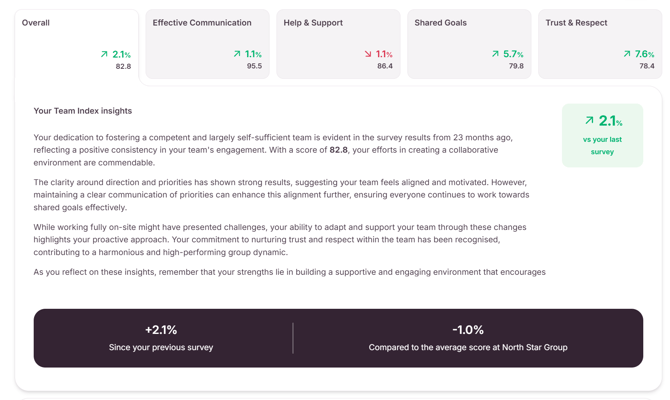
Instead of a single view of management effectiveness, results are now structured around three high impact areas: Clarity, Team and Coach. This makes it easier to see exactly where a people leader is strong and where development will make the biggest difference. The overall PLI is presented as a score, with the three indices shown as percentage points away from the benchmark.
What is the scoring scale?
The overall PLI is scored on a scale of 500 to 1000, with familiar star ratings retained.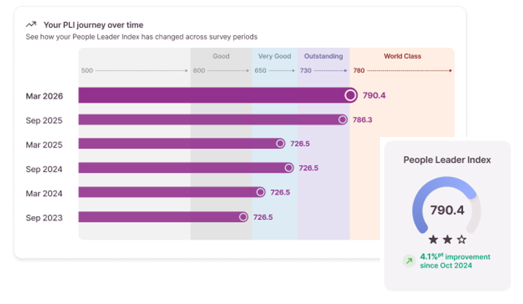
Why is the overall PLI a score, but Clarity, Team and Coach shown as percentage points from a benchmark?
The three indices and their elements are shown as a percentage because it is a familiar format that people find easy to read and act on. The overall PLI works differently because the scores behind it are standardised. Some statements are easier to answer favourably than others, and some have a wider spread of responses, so standardising is essential to keep the three indices balanced within the overall measure. Once scores are standardised, presenting the overall PLI as a percentage would look out of step with the index scores and draw people into questioning the numbers rather than using them. The 500 to 1000 scale gives the overall PLI a clear identity of its own.
Standardisation is a widely used statistical technique that ensures measurement sits on a common scale.
How are PLI scores calculated?
Scores combine a leader's latest responses with their prior survey results (if they have them) and wider organisational benchmarks, using established statistical techniques. The calculation accounts for the number of respondents per leader and places greater weight on larger and more consistent sets of feedback. For leaders of small teams surveying for the first time, scores are gently balanced against the consistency within the raw scores and wider benchmarks, giving a fair starting point. As leaders take part in further surveys, their results increasingly draw on their own prior data, so scores become progressively more tailored and precise.
Why might a leader's score look more stable than their raw responses?
Many leaders have a small number of direct reports, so results can be influenced by who happens to respond in each survey. Without careful treatment, this could make scores fluctuate more than underlying performance suggests. Our approach reduces this short term noise, keeps scores fair and comparable for smaller teams, and provides a more stable view of genuine performance over time.
Does the measure improve with repeated surveys?
Yes. As more data is collected, the measure becomes more sensitive to real changes in a people leader's performance. Genuine improvement can be identified with greater confidence, while avoiding overreaction to one off fluctuations. Over time this delivers a more reliable and representative view of underlying performance that supports confident decision making.
What is the difference between the BCI and PLI?
The Best Companies Index (BCI) is your company or workgroup's engagement score, out of 1000. Your PLI is also a score out of 1000, but it is an individual's score as a people leader. The two indices measure different things and are not comparable in any way, other than that both are out of 1000. BCI tells you how engaged your people are; PLI tells you how effectively your people leaders are creating the conditions for that engagement.
Because they are different measures, the score needed to reach a particular star rating is different for each index. That is nothing to worry about in practice, as the Elevate platform always shows you how far away you are from the next star rating.
How are star ratings allocated in PLI?
Star ratings are awarded when a leader's overall PLI reaches certain thresholds. These are based on percentiles, meaning a leader's score is better than a certain percentage of leaders in our reference data set:
|
Percentile |
Status |
PLI score |
|
20th |
Ones to Watch |
708.3 |
|
35th |
1 Star |
748.5 |
|
55th |
2 Star |
782.6 |
|
75th |
3 Star |
822.3 |
In many cases, a leader will simply want to know the score they need for the next star rating, and the platform shows this at a glance. For those interested in the detail, the thresholds sit at the percentiles shown above.
What it means for your organisation
What makes PLI valuable for our organisation?
PLI goes beyond measurement to deliver practical, business critical insight. It helps you:
- Identify a people leader's strengths and gaps quickly
- Focus development on three high impact areas: Clarity, Team and Coach
- Link people leaders' behaviour directly to engagement, retention and performance
- Drive meaningful, measurable change across your organisation
How is PLI different from traditional metrics?
Traditional metrics often focus on management effectiveness or operational delivery. PLI is different because it:
- Focuses on everyday people leader behaviours
- Measures how people leaders shape the lived employee experience
- Connects insight directly to development and action
- Reflects the needs of modern, hybrid workplaces
Will this change how we interpret our results?
Yes, but in a positive way. PLI makes results:
- Easier to understand through three clear pillars
- More actionable, with defined areas for improvement
- More relevant to current organisational challenges
People leaders will gain clearer direction on where to focus development for maximum impact.
How does PLI support a people leader's development?
PLI is designed to move beyond insight and into action. It enables:
- More targeted development conversations
- Personalised leadership coaching opportunities
- Clear priorities for improving engagement outcomes
- Stronger alignment between leadership behaviour and business goals
How does PLI impact organisational performance?
Strong people leadership is one of the most powerful drivers of organisational success. PLI helps organisations:
- Improve employee engagement and experience
- Strengthen team effectiveness
- Build high performing leadership capability
- Deliver sustainable business results
Why is this particularly important now?
In today's fast moving, often hybrid workplace, leaders have a direct and immediate impact on how employees feel and perform. PLI reflects this reality by focusing on:
- Clear communication and direction
- Team cohesion and collaboration
- Ongoing coaching and support
These are the leadership behaviours that matter most right now.
In Summary
PLI is a natural evolution of our previous MHI measure and a valuable tool to unlock better leadership performance, providing a framework to drive meaningful change at scale.
Better people leadership leads to stronger engagement, and stronger engagement drives better business outcomes.
If you have any questions or for additional support please email support@b.co.uk, call us on 01978 856 222, or click the 'Get in Touch' button at the top of this page.